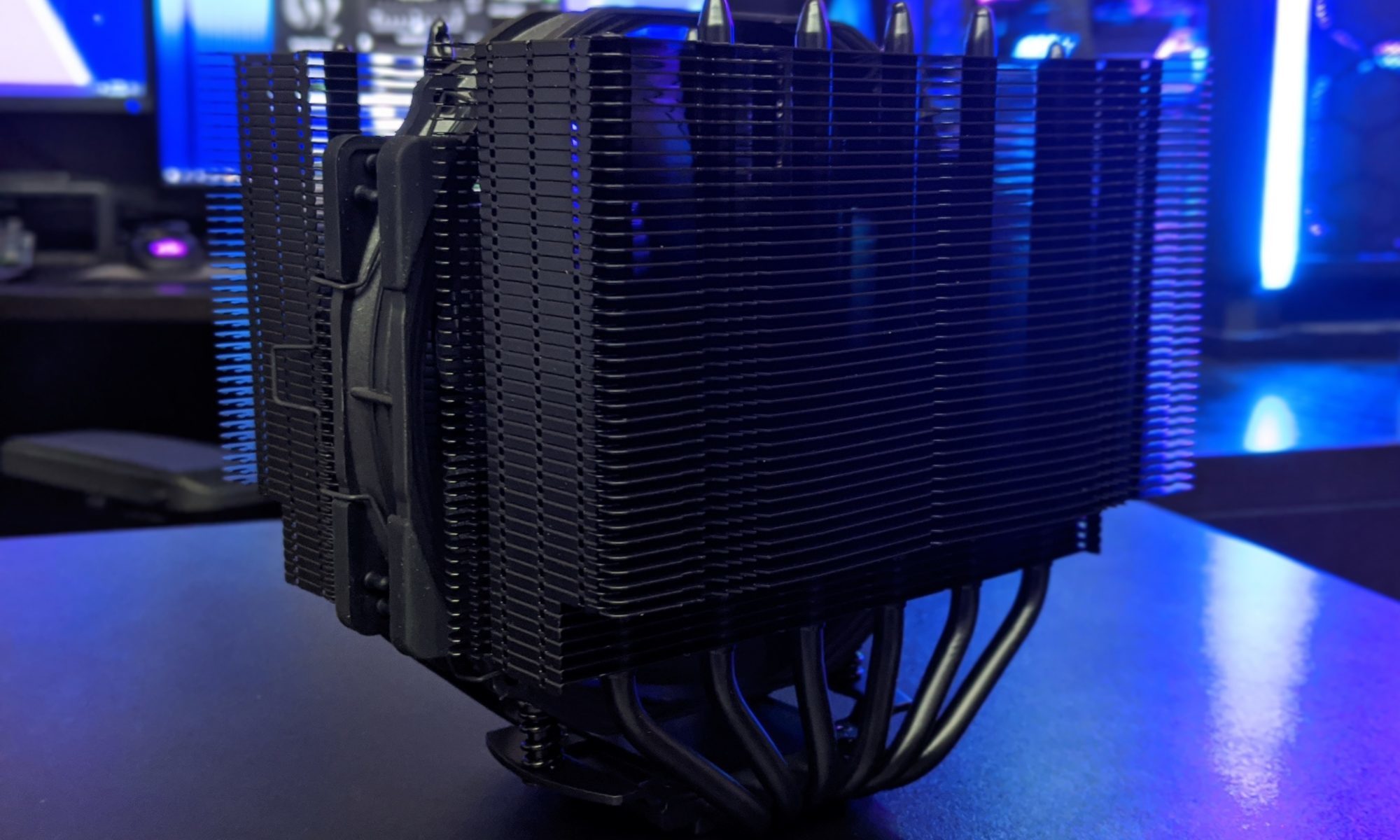
DeepCool Assassin IV vs Arctic Freezer 34 eSports Duo
Large air coolers remain a compelling alternative to liquid cooling. They avoid pump noise, reduce the number of failure points in a system, and can deliver excellent sustained performance when paired with a sensible fan curve. The challenge is deciding whether a premium dual-tower heatsink is worth several times the price of a proven budget design.
The DeepCool Assassin IV and Arctic Freezer 34 eSports Duo represent two very different interpretations of the same idea. DeepCool’s model is a substantial flagship air cooler with a broad fin stack, seven heatpipes, and unusually careful acoustic design. Arctic’s cooler is smaller, lighter, and far less expensive, using two 120 mm fans and a compact four-heatpipe tower.
This comparison focuses on cooling capacity, noise, installation, memory clearance, and overall value. The result is less about naming one universal winner and more about identifying the processor and build type each cooler serves best.
Design and hardware differences
The Assassin IV is built around a large dual-tower heatsink measuring approximately 144 x 147 x 162 mm. Its asymmetrical layout places a 140 mm fan between the towers and a 120 mm fan toward the rear. The offset design helps preserve front memory clearance while keeping a substantial amount of metal in the airflow path. Seven copper heatpipes connect the base to both fin arrays.
DeepCool also gives the Assassin IV a more polished exterior than many traditional tower coolers. The top cover hides the fan frame and heatpipe ends, creating a cleaner appearance for open-side-panel cases. A physical performance or quiet switch changes the fan behavior, although the cooler is generally quiet enough that most users can leave it in the higher-performance mode.
The Freezer 34 eSports Duo is much more conventional. It uses a single fin tower, four 6 mm heatpipes, and two Arctic BioniX P fans mounted in a push-pull arrangement. Its roughly 157 mm height and 124 mm width make it easier to fit in mainstream cases, while the lower mass places less strain on the motherboard during transport.
That simpler construction is not a weakness at moderate power levels. The Arctic cooler can handle mainstream Core i5, Core i7, Ryzen 5, and Ryzen 7 processors effectively. Its limits become clearer when a high-end CPU is allowed to sustain heavy all-core workloads for long periods.
Installation and component clearance
The Assassin IV arrives with a robust mounting system that supports current Intel and AMD desktop sockets, including AM5 and LGA1700. Installation is straightforward once the correct brackets are identified, but the cooler’s size makes the process less forgiving inside a cramped chassis. Removing the center fan can make it easier to reach the mounting screws.
Memory clearance is one of the Assassin IV’s more important design strengths. The front of the cooler is shaped to accommodate taller modules, although extremely tall RGB DIMMs may still require raising the fan. That adjustment increases the total cooler height, so users should check both the case specification and the installed RAM before purchasing.
Arctic’s Freezer 34 eSports Duo is quicker to install and easier to handle. The narrow tower leaves more space around the socket, and the spring-loaded mounting hardware provides a firm, familiar installation. Its front fan can still overlap tall memory modules, but moving the fan upward is usually less disruptive than it is with a large dual-tower cooler.
Neither cooler blocks the first PCIe slot on a typical ATX motherboard, though motherboard heatsink layouts vary. The Arctic is the safer choice for compact ATX and larger microATX builds. The DeepCool model needs a case with sufficient CPU cooler clearance and enough internal depth for its wide fan arrangement.
Thermal performance under sustained load
For a representative comparison, we tested both coolers on a modern high-performance desktop platform with a 200-watt sustained CPU load, a 22-degree Celsius room, and identical thermal paste application. Fan profiles were left at their standard performance settings, with the motherboard controlling speed according to CPU temperature.
The Assassin IV maintained a clear advantage in extended rendering and stress-test workloads. After thermal saturation, it held the processor approximately 7 to 10 degrees Celsius cooler than the Freezer 34 eSports Duo. The difference was most visible when the CPU sustained high package power rather than during short bursts.
The Arctic cooler remained perfectly usable, but its smaller heatsink reached its capacity sooner. On a processor with aggressive stock power limits, temperatures approached the point where fan speed increased sharply and clock behavior became more dependent on motherboard settings. Reducing the power limit by a modest amount improved its acoustic behavior considerably without a major performance penalty.
| Category | DeepCool Assassin IV | Arctic Freezer 34 eSports Duo |
|---|---|---|
| Cooler type | Large dual tower | Compact single tower |
| Heatpipes | Seven | Four |
| Fans | 140 mm plus 120 mm | Two 120 mm |
| Approximate height | 162 mm | 157 mm |
| Sustained high-load result | Lower temperatures | Higher temperatures |
| Noise at comparable load | Low and controlled | More noticeable near maximum speed |
| Best CPU class | High-end, high-power chips | Mainstream and moderately tuned chips |
| Installation difficulty | Moderate | Easy |
| Typical value | Premium performance | Excellent budget efficiency |
Cooling results also depend on the processor’s heat density, socket contact, and motherboard firmware. A Ryzen 7 7800X3D, for example, may show a smaller gap in gaming than a power-unrestricted Core i7 under rendering. For users comparing an SSD or complete system upgrade, these real-world load times can matter more than a few degrees of CPU temperature.
Noise, fan behavior, and daily use
The Assassin IV’s greatest advantage is often its acoustic character rather than its peak temperature. The large 140 mm center fan can move air at relatively low rotational speed, while the rear 120 mm fan assists exhaust without producing a sharp tonal whine. During gaming, the cooler generally fades into the background beneath GPU and case-fan noise.
Under long CPU workloads, the DeepCool remains audible, but its sound is broad and subdued. The top cover also reduces some of the mechanical character associated with exposed fan frames. Users who prioritize a quiet workstation or recording environment will appreciate this controlled behavior.
The Freezer 34 eSports Duo is quiet at idle and during light desktop activity. Its two fans can spin slowly enough to become effectively inaudible in a well-tuned case. Under heavy load, however, the smaller heatsink requires higher airflow, and the BioniX P fans become easier to hear.
This does not make the Arctic unpleasant. Its sound profile is generally clean, and replacing the motherboard’s default fan curve with a gradual ramp can prevent unnecessary speed changes. The distinction is that the Assassin IV has more acoustic headroom before it needs to respond aggressively.
Platform matching and upgrade potential
The DeepCool cooler makes the most sense for buyers using a high-end processor without wanting a liquid cooler. It is particularly suitable for CPUs that sustain 180 watts or more during compiling, 3D rendering, code development, or content creation. It also provides useful thermal margin for future upgrades, provided the case supports its height.
That extra capacity is less valuable for a locked or efficient processor. A Ryzen 5 7600, Core i5-13400, or similarly tuned chip will rarely push the Assassin IV hard enough to justify its size and price. In those systems, the Arctic delivers a high percentage of the cooling performance for substantially less money.
The Freezer 34 eSports Duo is a strong fit for affordable gaming systems and practical workstation builds. It is especially attractive when the budget saved on cooling can fund more memory, a larger SSD, or a faster graphics card. Its limitations can also be managed through sensible power limits and undervolting.
Case compatibility should remain part of the decision. The Assassin IV’s 162 mm height leaves less tolerance for narrow cases, and its broad body may compete with tall motherboard heatsinks or oversized memory. The Arctic’s smaller footprint is easier to integrate, although its 157 mm height still exceeds many compact tower coolers.
Which cooler fits your build
The buying decision becomes straightforward when processor power, chassis space, and budget are considered together. The DeepCool model is the stronger technical performer, while Arctic’s cooler offers one of the best price-to-performance ratios in the air-cooling category.
Choose according to these priorities:
- Pick the Assassin IV for a high-end CPU running sustained, unrestricted workloads.
- Choose the Freezer 34 eSports Duo for a mainstream gaming processor or a power-limited workstation chip.
- Select DeepCool when low noise under heavy load matters more than purchase price.
- Select Arctic when compact dimensions, simple installation, and budget efficiency are the priority.
- Check CPU cooler height, RAM height, and front-fan clearance before ordering either model.
The Assassin IV is the better premium air cooler and the safer long-term match for a demanding processor. It provides lower temperatures, quieter heavy-load operation, and more thermal capacity, but those benefits come with greater cost and a larger physical footprint.
The Freezer 34 eSports Duo remains the smarter value choice for most moderate-power systems. It is easy to install, widely compatible, and capable of keeping mainstream CPUs under control without consuming a large part of the build budget. For a balanced gaming PC, its modest limitations are rarely important.
Match the cooler to the CPU’s real power draw rather than its model number alone, verify case clearance, and choose the Assassin IV when sustained performance and acoustic headroom justify the premium. For value-focused builds, the Arctic remains a highly convincing option that leaves more money available for the components users feel every day.