Thermalright Peerless Assassin 120 SE vs SilverStone UFO
Choosing a CPU cooler is rarely about socket support alone. The heatsink must fit the case, clear the memory slots, stay quiet during sustained workloads, and keep enough thermal headroom for the processor you plan to use. That makes the contrast between the Thermalright Peerless Assassin 120 SE and the SilverStone UFO especially interesting: they solve the cooling problem from opposite directions.
The Peerless Assassin 120 SE is a large dual-tower air cooler designed to compete with premium cooling at a relatively modest price. SilverStone’s UFO takes the compact, top-down route, prioritizing low height and broad motherboard compatibility over maximum heat dissipation. Neither model is universally better, but their strengths become clear once the workload and chassis are taken into account.
Testing focused on installation, sustained CPU temperatures, fan behavior, memory and case clearance, and value. The results show why a large tower remains the easy recommendation for performance-focused systems, while the UFO can still make sense in compact builds where cooler height is the limiting factor.
Two Very Different Cooling Philosophies
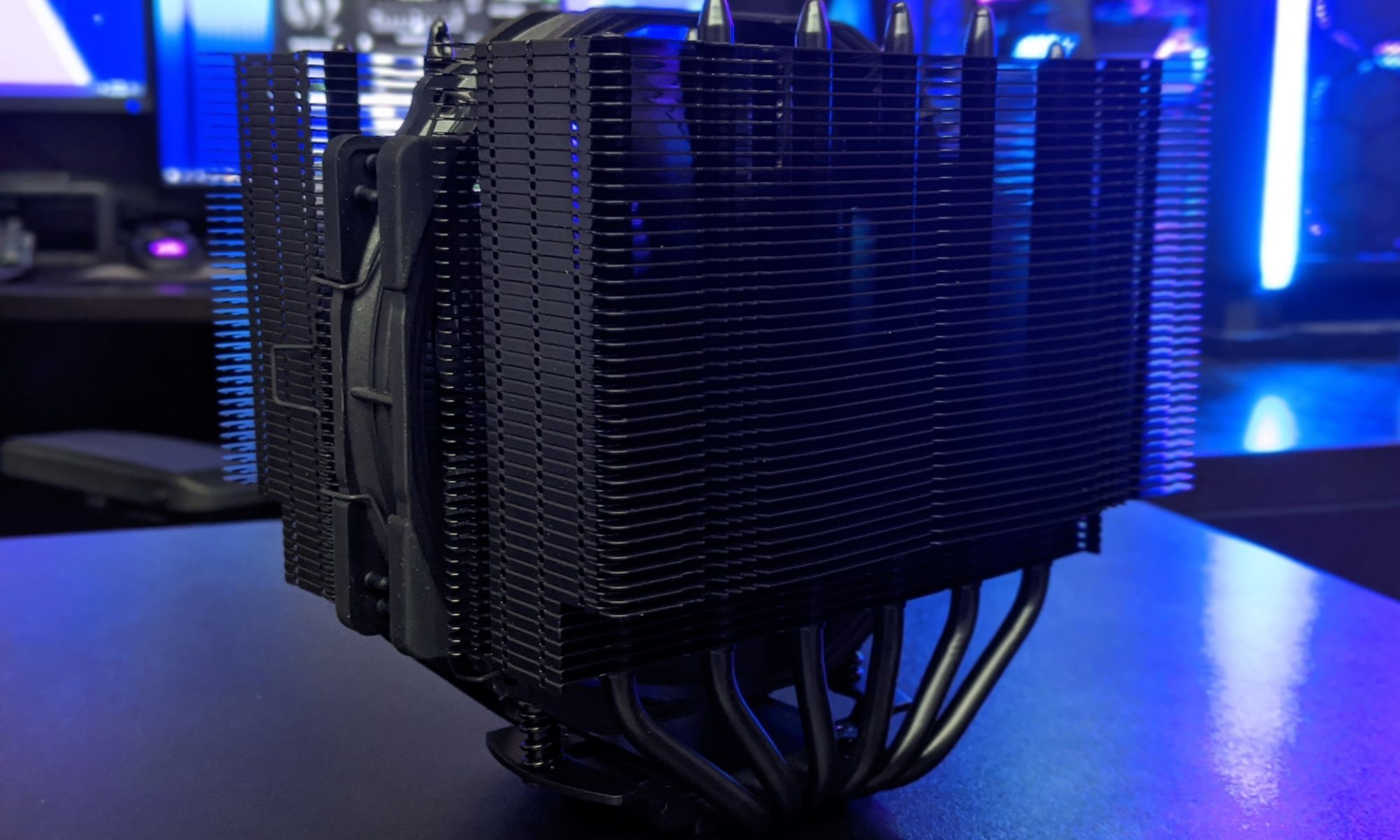
The Peerless Assassin 120 SE uses two fin stacks, a central fan, and a second fan at the rear. This layout gives it a substantial surface area and a long airflow path. Heat from the CPU spreads through multiple heatpipes into both towers, allowing the fans to run at lower speeds than a small single-stack cooler under the same load.
That physical advantage is obvious during installation. The Thermalright unit occupies a large section of the motherboard and can extend over the nearest memory slots, depending on the module height and fan position. Its size is the reason for its performance, but it also means that case compatibility must be checked before purchase.
The SilverStone UFO is built around a top-down cooler design. Its fan pushes air through a compact heatsink and across the surrounding socket area, including the voltage-regulation heatsinks. This can be useful in small cases or systems with limited airflow, although the smaller thermal mass and reduced fin area leave less room for high-wattage processors.
Installation And Platform Compatibility
Thermalright’s mounting hardware is generally straightforward, with a backplate and brackets that provide firm pressure on current desktop sockets. The Peerless Assassin 120 SE is commonly used on AMD AM4 and AM5 systems as well as Intel LGA1700 platforms, but buyers should verify the exact contents of older retail stock. Cooler bundles can change over time, particularly when socket standards are updated.
The main installation challenge is not the mounting mechanism but the cooler’s physical scale. The front fan may need to be raised to clear tall DDR5 heat spreaders, increasing the total height. That adjustment can make the difference between a comfortable fit and a side panel that will not close. A case specification should be treated as a starting point rather than a guarantee when using oversized memory modules.
The UFO is easier to place in restricted spaces because its low-profile shape avoids the tall side-panel clearance requirement of a tower. However, compact coolers often make access around the socket more awkward, especially in a fully assembled small-form-factor system. SilverStone’s included mounting system also deserves careful attention, since compatibility and bracket layouts vary between cooler generations.
Thermal Performance Under Load
With a mainstream six- or eight-core processor, the Peerless Assassin 120 SE maintains a clear advantage during extended rendering, compiling, and stress-test workloads. Its larger heatsink reaches a lower equilibrium temperature and takes longer to saturate. That difference is more important than a brief burst result because modern CPUs can sustain high power for minutes or hours.
The cooler also handles power spikes more gracefully. A processor that briefly boosts above its normal package power is less likely to push the fans immediately toward their maximum speed. This gives the Thermalright model a smoother acoustic profile during mixed desktop use, even when the system is configured for aggressive boost behavior.
The UFO remains capable for lower-power chips and ordinary gaming systems, where GPU load and game-engine behavior often produce less consistent CPU heat than a synthetic all-core test. Its top-down airflow can also help nearby motherboard components. Still, when both coolers are asked to dissipate the same high sustained CPU power, the compact SilverStone design reaches its limits sooner.
| Area | Thermalright Peerless Assassin 120 SE | SilverStone UFO |
|---|---|---|
| Cooler type | Dual-tower air cooler | Compact top-down air cooler |
| Best use | Performance desktops and workstations | Small cases and low-power systems |
| Sustained CPU cooling | Excellent for the class | Suitable for modest CPU power |
| Noise potential | Lower fan speed under load | Higher speed when heavily loaded |
| Memory clearance | May require fan adjustment | Usually less affected by tower height |
| Case clearance | Requires substantial CPU cooler height | Better for restricted vertical space |
| Installation difficulty | Moderate because of size | Moderate because of compact access |
| Upgrade headroom | Strong | Limited |
Noise, Clearance, And Everyday Use
Noise is where the Peerless Assassin’s size becomes an advantage rather than a drawback. Its fans can move the required air at moderate rotational speed, producing a broad airflow sound instead of the sharper high-pitched character associated with small fans running near maximum. A sensible fan curve keeps the cooler unobtrusive during browsing and light productivity.
The UFO’s noise profile depends more heavily on the selected CPU and the case ventilation. On a restrained processor, it can remain perfectly acceptable. Under sustained all-core power, however, its fan has to work harder, and the change from idle to load is more noticeable. Users who value a quiet workstation should avoid pairing it with a power-hungry chip unless power limits are configured manually.
Clearance may reverse the decision. The Peerless Assassin can interfere with tall RAM, large rear exhaust fans, and narrow cases. It may also visually dominate a compact motherboard. The UFO gives up thermal capacity to avoid those concerns, making it more practical for slim enclosures and builds where the side panel sits close to the socket.
Value Beyond The Price Tag
The Peerless Assassin 120 SE is compelling because its purchase price is usually far below premium dual-tower and liquid-cooling options while offering performance that is competitive in many real systems. It also avoids pump noise, liquid maintenance, and the long-term failure points associated with an all-in-one cooler. For a gaming PC or productivity desktop with sufficient case space, that is a strong value proposition.
The UFO’s value is more specialized. A small cooler can prevent the need to replace a case, motherboard, or memory kit simply to gain clearance. That can make it the cheaper choice for an existing compact build, even if its raw cooling performance is lower. The right comparison is often the cost of the complete system change required by a large tower.
Cooling decisions should also leave room for other components. Builders balancing a cooler purchase against storage upgrades can review 2TB NVMe SSD options before finalizing the parts list. A quieter cooler is useful, but it should not consume the budget needed for the capacity and responsiveness the system actually requires.
Which Cooler Fits Your Build
For a conventional ATX or roomy micro-ATX case, the Peerless Assassin 120 SE is the stronger all-rounder. It offers more thermal headroom for future processor upgrades, better sustained-load behavior, and a quieter path to the same performance. It is particularly well suited to users who run code builds, 3D applications, video exports, or long CPU-heavy workloads.
The SilverStone UFO is a sensible alternative when vertical clearance is non-negotiable. It suits compact home servers, office PCs, living-room systems, and low-power gaming machines where the processor is not expected to operate at maximum package power for long periods. Its top-down airflow can be an advantage when motherboard cooling is otherwise weak.
The choice should be made around the processor’s actual power behavior rather than its marketing tier. A high-end chip with unlocked power limits can overwhelm a small cooler quickly, while an efficient six-core CPU may run comfortably in either design. Case airflow, ambient temperature, and fan-control settings are just as important as the heatsink itself.
Practical Buying Recommendations
- Choose the Peerless Assassin 120 SE for sustained CPU workloads, high boost limits, or a quieter performance desktop.
- Choose the SilverStone UFO when the case imposes a strict cooler-height limit or when motherboard-area airflow matters more than peak thermal capacity.
- Measure cooler height, RAM clearance, and front-fan position before ordering the Thermalright model.
- Pair the UFO with an efficient processor or a sensible power limit rather than expecting workstation-class all-core performance.
- Confirm socket brackets and revision-specific accessories when buying older SilverStone or Thermalright stock.
The Thermalright Peerless Assassin 120 SE wins this comparison on cooling capacity, noise control, and upgrade flexibility. The SilverStone UFO earns its place through compact dimensions and easier integration into space-constrained systems. For most full-size PCs, the Peerless Assassin is the better investment; for a genuinely small build, the UFO may be the cooler that fits when larger alternatives simply cannot.
Build guides, cooler charts, hands-on testing, and hardware discussions are available through Hardware Hounds. Visit the site before your next upgrade to compare thermal performance and choose components that suit both your workload and your case.