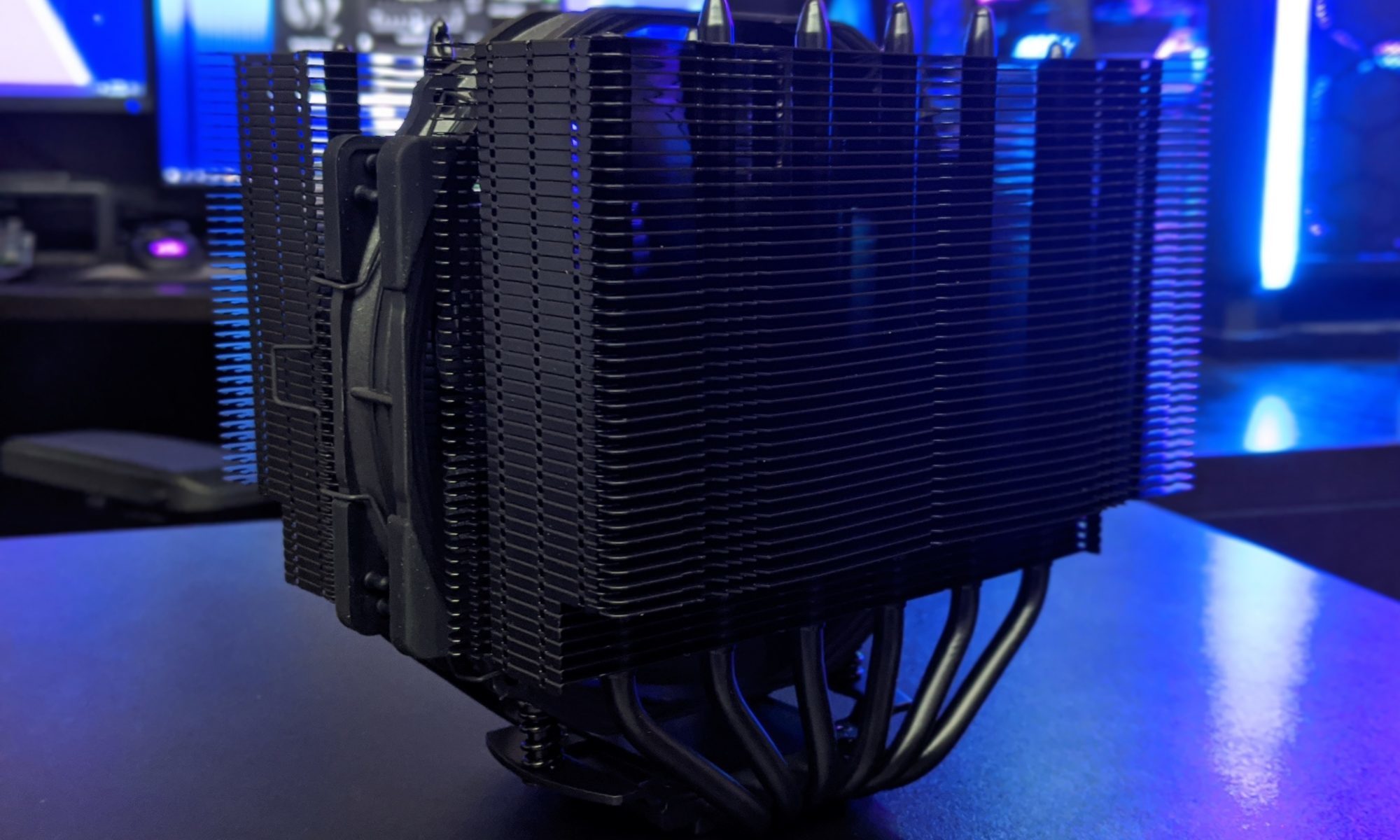
What Is a Good Case for Radiator Thickness? Testing 25mm vs 45mm
A case can advertise room for a “360 mm radiator” while still leaving little practical clearance for a thick core, its fans, fittings and tubing. That makes radiator thickness a case-design issue, not merely a choice between slim and beefy coolers. In this test, the question was simple: does a 45 mm radiator justify its extra footprint over a 25 mm model, and which cases can genuinely support either without component conflicts?
The answer depends on heat load, available fan pressure, case airflow and the dimensions of every part around the mounting area. A thicker radiator can run a hotter CPU more quietly, but a badly designed case can neutralise that advantage. The useful result is therefore a decision framework rather than a single winner, with test data showing where the performance gap opens and where it nearly disappears.
Why thickness changes the cooling equation
Radiator thickness describes the depth of the core and fin stack. Once a fan is attached, a 25 mm core with a standard 25 mm fan needs about 50 mm of physical depth; a 45 mm core with the same fan needs roughly 70 mm. Some cases quote combined measurements, while others list only the radiator, so checking the mounting specification and adding the actual fan thickness prevents an expensive discovery after the cooler is unpacked.
A 45 mm core usually contains more fins and coolant passages within the same face area. That increases thermal capacity and lowers coolant temperature when the pump and fans can still force air through the denser matrix. It also raises pressure drop, which means ordinary fans may stall at high static pressure or become louder. A 25 mm radiator puts less resistance in the path, making it easier to cool but requiring more fan speed for comparable results.
Building a fair 25mm versus 45mm test
To isolate radiator thickness, both units were 360 mm models with the same footprint, coolant, pump, fans and tubing. The test system used a Ryzen 7 9800X3D, an RTX 4070 Super and an airflow-oriented mid-tower. Sensors recorded CPU package temperature, GPU core and hotspot temperatures, coolant inlet and outlet readings, fan RPM and pump noise. Ambient temperature was held at 22 °C for repeatable comparison and then raised to 30 °C to resemble a warm Australian room.
Each cooler completed a ten-minute idle baseline, a twenty-minute all-core CPU stress test and a thirty-minute GPU loop. Fan speed was fixed at 1,000 RPM for the controlled comparison, then increased in 50 RPM steps until both options landed within one degree of the same CPU temperature. Repeated runs were graphed rather than relying on one peak reading. The side panel remained off during thermal testing, then a closed-panel run checked how real-world case restriction changed the result.
Configuration matters before the results are interpreted, especially when three fans are involved. This three-fan radiator layout illustrates why intake fans should face the front mesh and exhaust fans should pull air through the radiator in the same path. Pump blocks, hard tubes and bent fittings can consume another 20–30 mm, so the neat rectangle on a product diagram is rarely the whole clearance requirement.
What the temperature results showed
At the fixed 1,000 RPM setting, the 45 mm radiator delivered the stronger result. CPU package temperature averaged four to six degrees lower in the all-core test, and coolant temperature stayed correspondingly lower. The gain was smaller during lighter workloads because the faster CPU could keep its boost clocks within target without moving much heat into the loop. Under a sustained power limit, however, the thicker core had a clear thermal advantage.
For the GPU, the separation narrowed to around one to three degrees, depending on whether the comparison used the core or hotspot sensor. Modern graphics cards have substantial coolers of their own, and case intake air often affects the card more than radiator depth. The 45 mm unit still reduced peak loop and memory-junction temperatures, but the thin radiator could recover most of that gap by running its fans harder.
The most revealing comparison was matched temperature rather than matched fan speed. The 25 mm core needed roughly 300–500 extra RPM from its fans to reach the 45 mm unit's CPU result at the higher ambient temperature. With both sets of fans capped at the same limit, the thicker radiator won on both temperature and acoustics; without a speed cap, the thin option traded noise for only a small thermal improvement.
Cooling down in an Australian summer
Australian summers make radiator clearance more than a tidy issue. A room in Brisbane or Sydney can sit near 30 °C on a summer afternoon, while Melbourne heatwaves can push a closed gaming room into the low 30s before the PC even starts working. A 45 mm core gave the 30 °C test an extra margin, and the advantage grew after the case had absorbed heat from the CPU and graphics card.
That margin affects how the cooler is used, not just how it is advertised. Australian buyers often see radiator, pump and fan bundles quoted in AUD with GST included, and local stock can be more attractive than waiting for an overseas shipment. A locally available thin radiator may therefore deliver better value for a modest office PC, while a thick model makes sense when sustained gaming or creator workloads justify its price. Builders here often say they are “throwing a rad in” the front, a quick way to describe the visual impact of a substantial liquid cooler.
Noise airflow and fan configuration
Airflow determines whether the extra core volume becomes useful. The 45 mm radiator's denser fins need fans with enough static pressure to push air through them; using low-resistance, low-pressure fans can reduce flow and leave part of the cooler underused. Push/pull configurations improve pressure and help keep the fin channels clean, but they also demand more depth, power and another row of fans. The best layout routes cool air directly through the radiator rather than mixing it with stagnant case air.
Noise is the practical separator. At equal RPM the 25 mm cooler was often the quieter of the two because it imposed less restriction on the fans, but at equivalent CPU temperature it needed a faster fan curve and became the louder system. The 45 mm setup could settle on a lower and steadier RPM, which also reduced the sudden burst of noise during a spike. Pump noise changed little, although the greater pressure drop occasionally made the pump work a little harder.
Checking every clearance
A good case for radiator thickness must be judged from the mounting zone inward. Measure the distance between the fan mount and the nearest obstruction, then add the combined thickness of radiator, fan, fittings and tubing. Do not subtract tolerances from the published number: a 70 mm assembly mounted in a nominal 70 mm bay may still foul because the fan frame, screw heads or side-panel bow take up space. Cases with adjustable mounts and multiple fan positions are more forgiving, but only if the relevant position reaches the CPU socket.
Orientation changes what that clearance means. In a top-mounted layout, thickness rises toward the side panel and can reduce space for tall memory or a protruding CPU cooler. At the front, a thick assembly pushes inward toward the board, potentially overhanging the socket or conflicting with large RAM modules. At the bottom it can shorten usable graphics-card length, and at the rear it is usually the least practical choice. Measure the assembled parts, not an empty case.
Choosing a case that suits your hardware
The best choice for a low-power CPU, compact build or restricted budget is often a 25 mm radiator. It fits more cases, places less load on the pump and needs less depth for push/pull additions. A 45 mm radiator is the stronger option for high-wattage processors, silent operation under load, overclocking and hot rooms, provided the case has at least 10 mm of sensible assembly margin. If a case supports only 50 mm in that position, a thick cooler is not a sensible purchase.
Value also depends on whether the case can supply clean, unrestricted airflow. A cheap 45 mm radiator behind a restrictive dust filter can perform worse than a slim model fed by a high-static-pressure fan. Extra intake and rear exhaust fans may fix that, but they add cost and noise, so include them in the comparison. Checking review photographs for cable routing, fan-to-fan gaps and side-panel clearance is more reliable than relying on a single maximum-radiator label.
For a model-specific verdict, send the case name, motherboard, memory height, graphics-card length and planned cooler through the Hardware Hounds contact page. A genuinely good case is not simply one that accepts the largest advertised radiator; it supports the chosen core and fan combination without clashes, preserves component clearance and allows the cooling system to run at the speed and noise level you want.